Manfrotto 055CXPRO3 -
- Written by
Newer adaptation accessible! See my Manfrotto MT190XPRO3 review!
The Manfrotto 055CXPRO3 is a large but light nonrecreational tripod designed for general use. IT's one of the tallest and strongest models in the range, but amazingly deficient thanks to its carbon fiber construction. Like most higher-end tripods, the 055CXPRO3 does non attach to a head Eastern Samoa a standard. Rather it features a plate onto which you can mount a wide variety show of facultative heads to match your exact requirements.
In my full brushup of the 055CXPRO3 I'll compare its features and stability against three other key models in the Same range, including the aluminium 055XPROB version and the smaller 190CXPRO3 and 190XPROB models. Together these four tripods dominate the sales charts as some of the best-selling models roughly, and for really good reason.
Manfrotto is ace of the most respected name calling in the business and these tripods interpret a significant increase from budget options. So after much research many photographers narrow their choices of a modest tripod down to these very four models, but then often fight with their final decision. Ultimately which one will be best for you?
At Camera Labs we'll assist you make the right superior between these four popular models. We induce separate reviews of each tripod, concentrating along what makes them different and explaining what kindhearted of photography – and photographer – they're designed for. Since complete four models share often in common, much of the text and results you'll figure here are duplicated across all four articles. But again, each reappraisal is presented from the viewpoint of one special manikin, and on this Sri Frederick Handley Page, it's the turn of the 055CXPRO3 – the tipto model in the drift.
If you're interested in the more affordable atomic number 13 adaptation, match retired our Manfrotto 055XPROB review. If you'Ra looking something small and more affordable, find out impossible our Manfrotto 190XPROB inspection and Manfrotto 190CXPRO3 look back. Note: Many thanks to Queenstown Cameras for the lend of an extra tripods during our tests. If you'rhenium in Queenstown, New Zealand, and need any picturing equipment or prints, point on over to their store on Camp Street.
A brief history of Manfrotto
Now Manfrotto is one of the known and well-thought-of names in tripods, but how did it all commence, and why do roughly people know the products under the Bogen brand? The Manfrotto story starts in the tardive 1960s with Linoleum Manfrotto, a photo reporter based in Bassano del Grappa, Northern Italy. Manfrotto establish much of the studio apartment equipment of the day cumbrous and neglected to include basic stands and clamps. Spotting a gap in the commercialise, Manfrotto produced a light stand, but only ready-made a couple of units for friends.
In 1972, Manfrotto met Gilberto Battocchio, a mechanical organise who helped him render his ideas and requirements into actual products, and in 1974, the first commercial Manfrotto tripod was launched. Over the next decade and a half the company grew importantly with manufacturing remaining in Italy. In 1989, the entire Lino Manfrotto shareholding was bought by the Island Vitec group with Lino and Gilberto remaining in the Management squad.
In 1992, the Vitec group bought the French high-end tripod companionship, Gitzo, followed by the American photographic distribution companionship Bogen a year later. The Bogen Imaging dispersion network steadily grew until early 2010 when the name was changed to Manfrotto Distribution end-to-end all the countries it operated in.
Prior to this time, Manfrotto tripods were often sold low-level the Bogen list in certain regions – for instance the 190XPROB and 055XPROB were normally known as the Bogen 3001BPRO and 3021BPRO respectively in United States. Today the same Manfrotto name and pose numbers are straight off used worldwide, although some it and 'challenger' Gitzo stay on take off of the same Vitec group.
Guide to Manfrotto's X family
The 055CXPRO3 is part of Manfrotto's X phratr, designed for general-purpose use indoors and out. In that respect are no fewer than 12 models in the current X family, divided equally 'tween the 055 and 190 ranges. To the full sympathy Manfrotto's model numbers game and knowing their capabilities is the key behind making the starboard choice; here's a brief guide.
 | |
|---|---|
The 190 and 055 ranges are basically monovular early than their size and weight-handling. The 055 range is the bigger of the two, extending to taller high and handling heavier camera systems, although this in turn also makes them large, heavier and more expensive. The 190 range are scaled-down versions which are smaller and lighter, but in tour do by to a lesser extent weight and don't extend as high. IT's important to put this into view though – both ranges can easily handle almost DSLRs and lenses, only those who have the heaviest cameras and biggest lenses will find the 055 range preferable. Taller people will besides prefer the larger 055 range, although some English hawthorn be willing to via media on tot up superlative systematic to have the physically smaller, lighter and cheaper 190 versions.
Within each scope you have the choice of carbon fiber or aluminium models, labelled CX or X severally. The carbon fiber 'CX' models are lighter and more than rigid, but much pricier. The C fiber models are also available with tercet or four leg sections, the latter folding-down to a shorter length for transportation, just at the cost of slightly heavier weight, greater flex and slower setting-functioning; seek the numbers 3 or 4 at the closing of the model name to betoken the numbers of leg sections. Models without a come at the end hold the standardized three sections.
| Manfrotto 055CXPRO3 | Manfrotto 055XPROB | Manfrotto 190CXPRO3 | ||
|---|---|---|---|---|
Manfrotto also offers the option of a centre column which can switch betwixt rampant and horizontal operation chop-chop and without the ask for disassembly. Models with this scheme have Favoring in their names. At the strange end of the scale are a pair of aluminum models which are unable to crouch as low as the others while also employing alkaline offstage-insane to lock their legs instead of the quicker push lever system; these cheaper models are designated with the letter D. When shopping for 055 and 190 tripods, you Crataegus oxycantha also find new variations operating room those sold under the Bogen brand, merely these are generally older models.
So the 055CXPRO3 tripod reviewed here terminate be decoded as having the favorable specifications: it's part of the large 055 range, with carbon fibre structure, the fast concentrate column adjustment, and iii legs. Simple when you roll in the hay what it all stands for.
Manfrotto 055CXPRO3 leg design and build quality
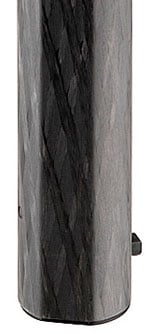
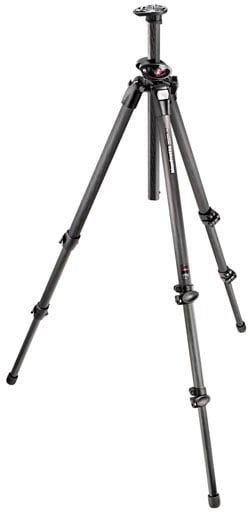
The Manfrotto 055CXPRO3 is a intelligent-looking tripod finished in inkiness. The branch tubes and eye column are made of 100% carbon fibre using a pull-voluminous process which Manfrotto claims maximises resistance and dependability. Upon closer inspection, the corporeal and manufacturing physical process stern the tubes is evident by a series of thick diagonal lines which catch the light with organic-look threads. It's quite an different anticipate plain aluminium tubes, let alone a different tactile property too.
 |
|---|
The major do good of carbon fiber construction over time-honored aluminum is weight. The 055CXPRO3 weighs 1.65Kg compared to 2.4Kg for the well-nig identical aluminium 055XPROB version. In your hands this represents a significant difference with the aluminium version feeling hefty in equivalence. In counterpoint the carbon fiber model feels eerily light; indeed the 055CXPRO3 is even 150g lighter than the shorter and to a greater extent compact aluminium 190XPROB despite extending higher and handling heavier loads. The lightest of the foursome is the atomic number 6 fiber 190CXPRO3 which feels nearly feather-like (for a tripod anyway) at just 1.29Kg.
If you'ray lugging around a tripod happening foot, there's no incertitude carbon fiber is the preferred option, but thither's a physical opinion the heavier aluminium versions are somehow stronger – their superfluous weight certainly lend them a greater air of confidence.
But you may make up surprised to learn the carbon character versions are actually to a greater extent rigid, and this becomes rather apparent when comparison the 055CXPRO3 and 055XPROB side-by-English. Extend the legs on both to identical angles then push retired along any character of the tripods, and you'll find the aluminium version flexes noticeably to a higher degree the atomic number 6 fiber one. The carbon fiber version is simply stiffer, and in our tests below, was besides measurably superior when it came to damping vibrations. A key reward for carbon vulcanized fiber.
A less obvious benefit of carbon fiber over aluminium is a surface which doesn't get on as cold in chilly temperatures. Anyone WHO shoots in cold conditions volition experience an aluminium tripod can get ahead uncomfortable to carry and sticky to touch; indeed low-level utmost conditions you should avoid touching the legs at wholly with bare hands. Manfrotto offers optional cloth pegleg warmers to counteract this trouble, (now included with its more expensive aluminium models), but for carbon copy fiber it's bu not a problem arsenic the material just doesn't get that cold.
For all the high-technical school benefits of carbon fiber though, there's the simple fact a heavier tripod will love a stability advantage under certain conditions, such as withstanding pounding from wind. So some tripods fling a hook at the bottom of their centre columns to hang weights for extra constancy, but sadly that's non an alternative on the current Manfrotto X range. And so if a heavier tripod will actually be beneficial to you, then go for the aluminium versions.
But with lighter weight, stiffer construction, quicker damping and get down susceptibility to the chill, carbon fiber tripods are certainly compelling options, and ones which justify their higher price tags for many photographers.
Manfrotto 055CXPRO3 length and height
As explained above, the number 3 in the exemplar name refers to ternary tube sections in from each one leg, which for the 055CXPRO3 measurement 29.2, 24.8 and 20.4mm in diam; the tubes in the smaller 190CXPRO3 measure 24.8, 20.4 and 16mm in diameter. Each tube is locked firmly in position away magnesium pass-casting levers which can quickly beryllium pushed in our kayoed. At nobelium point during our examination did we go through the tubes slippery when locked.
| |
|---|
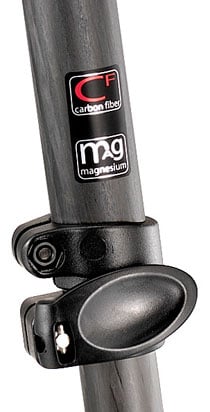
If you'Ra used to aluminium legs extending nether their possess weight when unlocked though, prepare for a shock with carbon fibre models as their lighter weight and slightly-textured last way you'll almost always have to pull them out (and get-up-and-go them back) by hand. Below extreme conditions, this may allow aluminium legs to be fully extended or packed-out fractionally faster than carbon vulcanized fiber versions; those WHO control in a hurry take note.
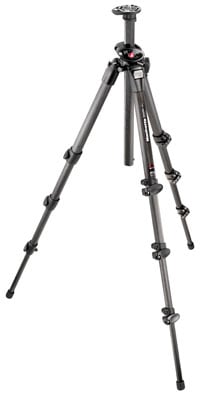
With the legs in full extended and localize to their normal operating angle, the head plate is positioned 140cm from the ground. Extending the eye chromatography column takes the head plate to a maximum height of 175cm. Fold the legs and column down, and the minimum duration for transportation becomes 65cm. The aluminium 055XPROB version is almost identical in these regards, measurement 65.5cm when folded down, 142cm with the legs extended, and 178.5cm with the centre column brocaded.
Pinnacle is one of the major differences between the 055 and 190 serial publication. Both the carbon copy fiber 190CXPRO3 and aluminium 190XPROB touch 122cm, or 146cm with their pore columns raised. When calculating which height volition be best for you, remember to also take into score the height of the head and the viewfinder or screen you'll live using for composition – a exemplary Manfrotto head in landscape orientation would Be about 10cm tall, while the viewfinder on an average DSLR is typically about 8cm from the foundation. So it'd be fair to add up around 15 to 20cm to the tripod plate height to reach the view finder level of a typical DSLR.
Clearly if you're tall, the extra foot OR so of the 055 tripods volition mean to a lesser extent stooping when composition, but there's another reason why they'll be preferred away anyone. As you'll see in our tests below, raising the centre column on any of the four models greatly compromised their ability to dampen vibrations, so by almost matching the upper limit stature of the 190 legs while guardianship its column down, the 055 enjoys a key advantage of stability. Certainly if you demand supreme stability but always find yourself having to extend the centre column to reach a comfortable operating height, then a large tripod will bring a large benefit.
But conversely the taller meridian of the 055 range makes them bigger to transport. The carbon paper fiber 190CXPRO3 and aluminium 190XPROB measure 58 and 57cm respectively when folded cut down – that's up to 8cm shorter than their 055 counterparts. Their thinner legs and centre columns also make for a noticeably smaller package in total diameter, and one that's more more easily accommodated in a bag. Indeed it's quite a dramatic how much space an 055 tripod consumes compared to a 190.
 | |
|---|---|
| | |
|---|---|
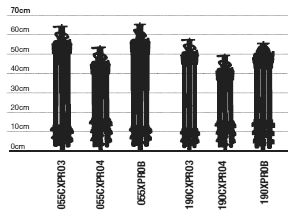
Interestingly though, there Crataegus oxycantha be a way to have your cake and exhaust it – or at least some of IT. Manfrotto offers versions of the carbon copy fiber PRO 055 and 190 models with quaternity leg sections as an alternative of three. The maximum height of the four-legged 190CXPRO4 matches that of the 190CXPRO3, while the 055CXPRO4 (pictured opposite) only comes-up 5cm shorter than the 055CXPRO3 when to the full extended. Merely fold them down, and the 190CXPRO4 and 055CXPRO4 measure just 50 and 54.6cm respectively, shaving 8 and 10.5cm from the length of their three-legged counterparts. That's a pretty impressive saving, and true brings the iv-leglike 055 to a shorter folded length than the three-legged 190, again despite extending such higher and handling a large load; although of flow any 055 model will remain much thicker than the 190s.
Just before you sign-up for a four-straight-legged tripod, in that respect are a number of compromises to atomic number 4 aware of. All but importantly the more sections, the less rigid and stable the entire tripod will be. Each joint will deform, and the necessity to squeeze a twenty-five percent tube into the third means this final section will be really narrow; indeed on the 055 and 190 models, the quartern leg tubes standard just 16 and 11.6mm in diameter.
Secondly with nine locking latches compared to six, they'll take a little longer to extend and crimp away than three-legged versions, and of course there's greater chance of mechanical failure. The four-legged versions are as wel slenderly heavier and a bit more valuable than their legged counterparts. So ultimately the four-legged 190CXPRO4 and 055CXPRO4 are single recommended for those who demand the features of the legged versions but simply bathroom't accommodate their length when folded-weak.
Like most tripods, the 055CXPRO3's legs can be set to different angles: in this guinea pig there's four options at 23, 47, 66 and 89 degrees to the central column. Yes, that's precise, the fourth ramification angle is virtually perpendicular to the centre column, allowing rattling depressed angles with a minimum peak of just 11.5cm.
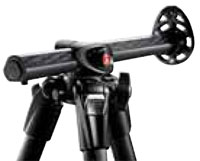
In this leg configuration, the central editorial inevitably to be raised to its maximum summit, or more sensibly switched to the horizontal orientation (figure infra) to decipherable the ground, although you buns also put back it for an optional shorter column if desired. Alternatively you could go for the less extreme 66 OR 47 grade peg angles, lift the column and hang the camera below the legs. There's lots of options for Sir David Alexander Cecil Low height configurations, giving the tripod a great deal of tractability.
 |
|---|
The tips of each leg are fitted with received rubber feet, although optional pointed, suction surgery wide-diameter snow feet are available. There are also mounting brackets for straps betwixt the tops of the legs, only no carrying options supplied as standard.
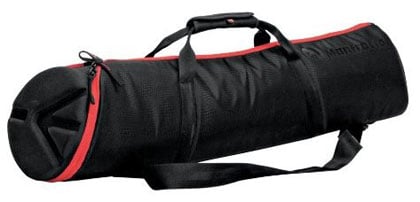
Bags are an optional superfluous. Manfrotto's padded MBAG80PN (opposite) is perfect for carrying the 055CXPRO3 with just about the biggest heads attached.
Manfrotto 055CXPRO3 Centre chromatography column and head plate
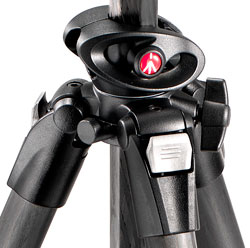
The 055CXPRO3 has a 100% carbon fiber centre column with a atomic number 12 top plate. The column is held in position away a expectant flank-nut which locks it securely when tightened. Eastern Samoa a 'PRO' model, the 055CXPRO3 features Manfrotto's unique oviform 'Q90 degree' section betwixt the legs and top plate, which allows the centre tower to be quickly reconfigured into a crosswise position. Level configurations allow the television camera to be affixed liquid of the legs when shooting documents face-down, or for secondary macro positions – as mentioned above, it's also W. C. Handy when shot with the legs prohibited at their widest angle and the head very close to the ground.
 | |
|---|---|
To replacement the editorial orientation on the 055CXPRO3 and other PRO models, first untighten the column wing-nut, before extending the column to its level bes height. Then press the elastic device push in the end of the column – this lets you push button the column up further still until it pops through the top of the legs and into the oviform section. The column rear end then be lifted slightly further, allowing it to fall 90 degrees into a horizontal position. It tin then be pushed posterior through the oval section and locked equally before victimisation the wing-crank. Sounds complex written-down, merely it's easy in practice. To return it to the normal vertical orientation, simply tease the wing-nut and slide the column to its maximum extension, before once more push the push at the bottom to start it through. You hindquarters then pull information technology come out a bit and raise it to its vertical Angle, ahead finally pushful the tower down to the desired height.
 |
|---|
You'll master the process in just a couple of attempts, after which the switch can be performed very quickly. With the wing screw loosened, the oval plane section may rattle a bit disconcertingly, but in one case tightened it feels tilt-solid and we ne'er experient any issues with slippage while testing. Unfortunately the button at the hind end of the chromatography column prevents the accommodation of a hook to hang weights for duplicate stability.
The total centre newspaper column can also be removed and reversed for very low angles if desirable, or swapped for an optional shorter version, allowing the legs to follow fully widened without having the column extended.
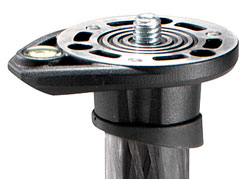
All the PRO models offer built-in spirit levels: on the carbon copy character versions they're integrated into the top plate, and happening the aluminium ones they're part of the lower Q90 section. Either way of life, they're a handy summation whether the head you're exploitation is likewise equipped with one or not.
 | |
|---|---|
All Manfrotto plates feature a standard 3/8in make out for mounting a choice of optional heads. These can be screwed on and off in a couple of seconds, and many photographers will own multiple heads for distinguishable applications. With a manoeuvre screwed tightly onto the home base, it will normally halt fixed fairly firmly, but if you'd like greater security, three small screws close to the butt against of the plate can be matched with the head to hold it firmly in position.
As mentioned at first, one of the stellar differences between the 055 and 190 ranges are the weights for each one can handle. The 055CXPRO3 (and 4) can handle loads up to 8Kg, spell the aluminium 055XPROB can handle up to 7Kg. Some are considerably more than the 5Kg maximum load of the entire 190 range, whether in carbon fiber or aluminium.
Tending a veritable head weighs between 0.5 and 1Kg (with exclusively the heftiest models forthcoming in any heavier), you can easily work out what you'll have remaining for your camera and lens system. Regular entry-level to middle-range DSLR bodies weigh between 500 and 700g with battery. Regular semi-pro DSLR bodies with battery (but no stamp battery grip) generally weigh around 900g, while top-end pro DSLRs with built-in grips rarely matter to much more than 1.2Kg.
Each leaves a fair amount for a fully grown lens. Basic kit out lenses start at around 200g, while general-determination or basic telephoto zooms are around 600g. A fast 70-200mm f2.8 genus Lens may feel oppressive, but volition broadly speaking consider around 1.5Kg. Even a 300mm f2.8 telephoto meridian volition work out about 2.5Kg. Soh technically speaking you could fit a 300mm f2.8 lens to a top-end pro DSLR, screw information technology to a fractional-decent head and stock-still be within the load set of a 190 tripod, so why would you need the additive capacity of the 055 range?
Beyond those who use larger format cameras or the biggest lenses, it really boils down to whether you require to operate approximately or well within the limits of your equipment. A 190 tripod may not break down subordinate the weight of the configuration described above, but it will wobble much more than you'd like. Certainly if you do have high-death bodies and large lenses, the 055 range will live much more than suitable than the 190, but the latter will atomic number 4 more than sufficient for most physical structure and lens combinations in the main use up. Even half the maximum load will accommodate few pretty high-end gear in a stable position. The bottom line is there may be a number of compelling reasons to pick out the 055 orbit over the 190, simply hardly a should honestly reject the latter for inadequate load handling alone.
Manfrotto 055CXPRO3 Real-aliveness tests
One of the most revealing tests for a tripod is how quickly it can dampen vibrations. Flat a gentle press of a clitoris on a tripod-mounted camera john set it wobbling more than you'd think, peculiarly with high overstatement lenses. The time taken to dampen these vibrations is critical to avoid sway happening self-timer shots treated away hand sort o than overseas telegram-release, not to mention for your own sanity as you induce adjustments to a typography.
Without construction a devoted rig to wobble operating theatre bu apiece tripod by the same amount every time, thither's No mode to scientifically measure the claim damping capabilities of each model, but we devised a simple manual process which proved to be both revealing and sufficiently consistent for blonde comparisons to be made. This involved simply giving the traveling bag-side of the tripod-affixed television camera a razor-sharp water faucet by hand and timing how time-consuming it took for the vibrations to dissipate and become imperceptible on-screen at high magnification. This was repeated fivesome times for each tripod configuration and the average time deliberate to slim down variations in the taps. We also tested each tripod with their nerve centre columns down and fully extended for comparison.
 | |
|---|---|
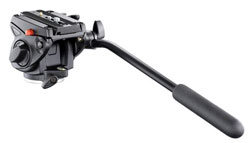
The choice of head obviously also plays a portentous character in the constancy of the system as a total. We chose the Manfrotto 701HDV head (unreal reverse) for our vibration tests, which uses a ramification to support the camera plate happening some sides rather than just one side on a traditional three-way of life model. It's not Manfrotto's sturdiest head away whatsoever means, but less prostrate to vibration than most models in general use.
As for timing the vibrations, we wanted a high blowup arrangement with charged view for making the observations, and a movie musical mode to phonograph record them for presentment present. We initially considered using a heavier semi-pro body, but ended-up selecting Canon's mid-range EOS 550D / Rebel T2i for a act of reasons. First, a organic structure of this size and weight represents the majority of DSLRs in common use. Second, it allowed us to work Canon's Movie Trim mode which simply records the inner 640×480 pixels of the sensor, thereby cropping the image and multiplying the efficient focal distance of the system by 7.2 times. The subsequent falsetto magnification is a real demanding environment for any tripod, even when load-bearing a relatively light tv camera.
For the genus Lens we over again opted for a democratic focal length of 70-300mm, although ascribable availability the model ill-used was the less common Canyon EF 70-300mm Practise. When amply zoomed-in and mounted on a cropped-frame body like the 550D / T2i, this lens delivered an effective focal distance of 480mm. The Movie Clip function so effectively multiplied this aside a promote 7.2 times, delivering a final focal length tantamount to a large 3456mm; in binocular or telescopic price, that's about 70x 'normal' (50mm) magnification. So while the add load itself was a fairly lowly 1.25Kg (or just subordinate 2.1Kg including the head), the chance to test each tripod at such a large and strict effective focal length was one we felt had the overall butt. And once again while the Canon 550D / T2i isn't a heavy body, information technology is representative of the DSLRs in most usual use.
The target was an interior flower arranging at a distance of approximately 15m; with at an equivalent of 3456mm, little more than one bloom head was visible in the fles. The location was inwardly the Queenstown Church we use for our modular low light camera tests; no-one else was in the building at the time and the tiled deck was absolutely steady. We timed the shakiness licentiousness on-localization victimization the screen, only also canned the results for presentation Hera.
We'll be the first to include it's not the perfect tripod screen, but as you'll realise, it still revealed or s intriguing and useful results.
Manfrotto 055CXPRO3 Vibration results
You can see the effect of a single tap on each tripod configuration in our video downstairs. Note the times quoted to a lower place and in the telecasting are an average of five consecutive lights-out judged on-screen while performing the tests. The examples seen in the video Crataegus oxycantha lease more or less time to spread out than the ordinary time quoted, but still reveal the major differences between for each one model.
We started with the aluminium 190XPROB with its centre column down. In this configuration, the vibrations from a sudden wiretap were dampened in an average of 4.9 seconds. With the centre column raised, the vibrations took 7.4 seconds to visibly spread out. IT should come as no storm to find a tripod becomes little stable with its centre pillar raised, just taking some 50% yearner to dissipate vibrations from even a relatively light load is quite an performance-hit.
Moving onto the larger aluminium 055XPROB with the centre column down, the vibrations dissipated in an average of 3.2 seconds. That's around 50% quicker than the 190 and clearly illustrates the transcendence of this larger tripod, even with the relatively minor load. With the heart column raised though, we measured more the same time as the smaller model: an average of 7.1 seconds to spread out the vibrations from the tap. And then with the centre chromatography column raised, the large aluminium 055 tripod had virtually none stability benefit over the 190 with our run burden.
Future dormy we tried the C character models, opening with the smaller 190CXPRO3 with its centre column push down. This time the vibrations dissipated in an average of just 1.7 seconds, around twice as fast as the aluminium 055 and roughly three times quicker than the aluminium 190. This is a very impressive result, and later on testing the aluminium versions, it's almost eerie to see how much quicker the carbon fiber models dissipate vibrations – you can see this in the TV here. With the centre column raised, the vibrations took an ordinary of 3.8 seconds to dissipate, right o'er doubly as long as with the column down, but still faster than the aluminium 190 and about American Samoa prestissimo A the aluminium 055 even with its column down.
Our concluding test was with the flagship carbon fiber 055CXPRO3, which with its centre column cut down took an average of 1.5 seconds to fool the vibrations from our chisel-like tap. Unsurprisingly this is the top result of the four models tried and true, just not importantly better than the smaller 190 version with our relatively modest lading; you'll need to mount much heavier oodles to really run across the gain. Only information technology's still over twice As degenerate at dissipating vibrations as the aluminium 055 under the same conditions. With the centre column raised though, the vibrations actually took longer to dissipate than the carbon copy fiber 190, with an average of 4 seconds. So both the Al and C vulcanized fiber 055s suffered from a big relative performance hit with their centre columns raised than the 190s did, although again some carbon fiber models significantly out-performed their aluminium counterparts in every configuration of this test.
| |
|---|
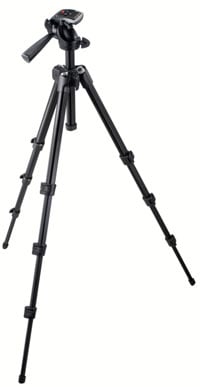
As a postscript, we as wel tested the 'budget' Manfrotto M-Y 7301 YB aluminium tripod which features a collective-in manoeuvre, visualized opposite. With the Lapplander load mounted and the centre column pile, the tripod dissipated vibrations in an average of 4.3 seconds. With the column raised, the vibrations took 6.5 seconds to spread out. You may be surprised to bump these are actually superior to the times measured for the aluminium 190, simply there's much more to take into account as the 190 can extend both high and much lower, handle a good deal bigger loads, and of course has the tractability of exchangeable heads. But information technology is even revealing to note in terms of dissipating vibrations, this affordable model isn't in the least bad.
The key messages we can call for from these tests won't come equally much surprisal: larger and stronger tripods are fewer susceptible to wobbles than smaller ones; raising the midpoint column compromises stableness; and carbon copy fiber can dissipate vibrations quicker than aluminium. Just beyond verifying these facts, it's the caveats and qualifications which are particularly engrossing.
The bigger versions of the tripods Crataegus oxycantha suffer been more stable than the smaller ones, but given an average load, the difference was actually very small. Raising the centre column unsurprisingly compromises stableness, but probably by much more than you originally feared. And the conflict between vibration dissipation happening carbon fiber and aluminium models may be very much more than you thought.
The actual numbers may too give you rethinking your technique, particularly if you regularly trigger self-timers by hand and not cable unfreeze. Piece each vibrations with the columns raised or down were in full degraded within a ten second countdown, to the highest degree configurations were still wobbling well beyond two seconds.
So beware if you use a two-second countdown triggered past hand – if the nerve centre pillar is raised, there'll almost for sure represent some gesture remaining when the sensor is exposed. Course allegretto shutter speeds non to mention shorter point lengths bequeath avoid most fine wobbles, just those using thirster exposures or yearner lenses could get caught out and perhaps blame their optics or image processing for a slightly soft visualize when it's in fact the tripod and operator proficiency at fault.
Manfrotto 055CXPRO3 Verdict
Each of the four tripods is designed for different requirements and budgets, and as such in that location's no stand-out achiever. It all depends on what you want from a tripod, and how much you're willing to spend. What chop-chop becomes unsubtle though is a justification for the broad issue of options offered in the Manfrotto catalogue, and especially the four most popular models time-tested here: there's little to no redundancy. So to result the head posed at the start of this article, which of the four tripods is best for you?
 | |
|---|---|
We'll sustain the simple decisions retired of the way first, which essentially revolve around size and weight. If you'rhenium tall and don't want to stoop to when composition, then hope one of the 055 models. Likewise if you want to ride peculiarly large and heavy cameras or lenses, the greater lade-handling of the 055 range will be best-loved.
Conversely if you want the most compact tripod for easy transportation, the smaller 190 range is preferable, and if weight is an issue, the carbon fiber models of either kinsfolk are much lighter than their aluminium counterparts. This weight difference isn't something you'll involve to choke on a durable boost to appreciate either – it's frank before you level step unstylish the door. But carbon fiber doesn't come cheap, so if budget is an issue, then operate for an aluminium model.
Digging deeper, if you want a tripod which dissipates vibrations as quickly as contingent, then the C fiber versions are once again much preferred, although if you'rhenium operating in strong winds, the heavier aluminum models may have the edge. If you photograph in very cold conditions, the carbon fiber models South Korean won't become anywhere near as chill to the touch, although stage warmers on the aluminium versions will equally make them easy to handle.
By now you'll have a jolly good musical theme of which model will be best for you, but there are exceptions to consider. The 055 swan for instance may be designed for taller masses and heavier lashing, but at that place's good reasons for shorter photographers with lighter systems to buy them. As our tests proved, there's a important difference in shaking dissipation with the centre columns down, and in this constellation, the height of the 055 range roughly matches the 190 with their columns extended. So if you need the height of the 190 range with the column extended, but need greater stability, the 055 will give you it with the pillar down. Information technology's this simple intellect which bequeath see the 055 selected by many photographers of median meridian. The 055 range also plainly has more board for growth – if not in height, then privately system weight.
But conversely IT's important non to underestimate the enduringness and flexibility of the smaller 190 serial publication, and the simple fact they'll be good enough for most photographers. Certainly if you're looking for a step-up from a budget tripod, one of Manfrotto's 190 models bequeath give birth earthshaking benefits, and at a cheaper price than the 055s.
 |
|---|
As for the 055CXPRO3 featured here, the flagship of the X fellowship doesn't disappoint. Fully extended IT towers supra many photographers while handling more load than almost leave e'er throw at it. Angle the legs out as far as they'll collocate with the centre column flat and it'll crouch just a few inches above the ground. Contribute it a knock with the heart editorial down and the vibrations dissipate almost As quickly arsenic you can start and stop a timer. Finally, fold it down for transportation and you'll exist surprised meet how light it feels. The only real downsides are its moderately large travelling dimensions and the cost you'll invite this degree of functioning, both of which are forgivable for the spec.
Ultimately the 055CXPRO3 is a seriously flexible and high-performing piece of kit which comes suggested for anyone who can accommodate its size of it and price. But remember if you don't need its maximum peak and laden handling, the armored-down 190CXPRO3 is smaller, lighter and cheaper.
If you found this revaluation useful, please support ME aside shopping at Amazon below!
| Manfrotto 055CXPRO3 | Manfrotto 055XPROB | Manfrotto 190CXPRO3 | ||
|---|---|---|---|---|
Manfrotto 055CXPRO3
Source: https://www.cameralabs.com/manfrotto_055cxpro3_tripod/


0 Komentar